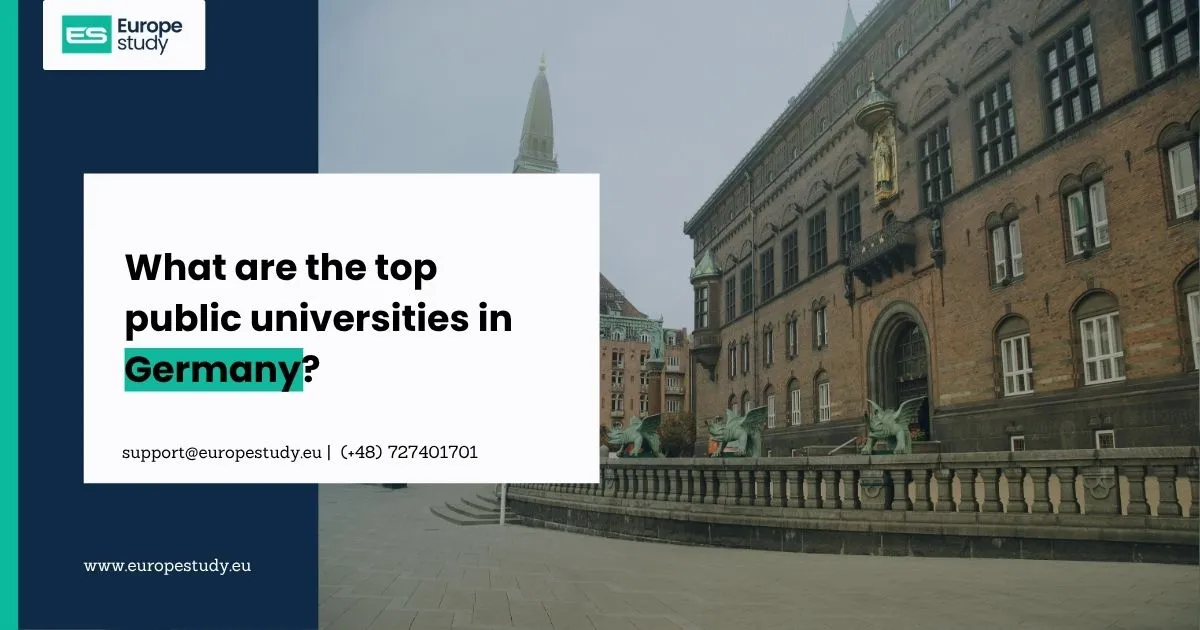
What are the top public universities in Germany?
What Are the Top Public Universities in Germany? A Complete Europe Study Guide for International Students
Germany has firmly established itself as one of the most attractive study destinations in the world, especially for international students looking for high-quality education at low or no tuition fees. With a strong tradition of academic excellence, deep industry connections, and a powerful research environment, German public universities offer a rare combination of affordability and global reputation. From world-renowned institutions like the Technical University of Munich and Heidelberg University to leading research hubs like RWTH Aachen and KIT, Germany has something for nearly every academic interest. A common question students bring to Europe Study is straightforward but important: what are the top public universities in Germany, and which one should I choose?
The honest answer is that "top" depends on your field of study, career goals, language preference, and long-term plans. Some universities lead in engineering and technology, others in medicine, business, social sciences, or arts. In this detailed guide, Europe Study introduces you to the top public universities in Germany, their key strengths, popular programs, tuition structure, English-taught options, admission requirements, and practical tips to help you choose the best fit for your study abroad journey.
Why Choose a Public University in Germany
Before looking at specific universities, it helps to understand why public universities in Germany are so highly valued by international students worldwide. German public universities follow a strong tradition that combines academic depth with practical relevance.
Most public universities in Germany charge little to no tuition for bachelor's, master's, and PhD programs. Students typically pay only a small semester contribution, which often covers administration, student services, and even public transport in many cities. This dramatically reduces the overall cost of high-quality international education.
Beyond affordability, public universities offer globally recognised degrees, strong research output, deep industry partnerships, and excellent post-study work and PR pathways. Many also offer increasing numbers of English-taught master's and PhD programs, making them accessible to students who do not yet speak German fluently.
Categories of Public Universities in Germany
Germany's higher education system includes several types of public institutions, and understanding the difference helps you make smarter choices.
Universities (Universität)
These are research-focused institutions offering bachelor's, master's, and PhD programs across a wide range of disciplines, including humanities, sciences, engineering, law, medicine, and business. Examples include LMU Munich, Heidelberg University, and Humboldt University of Berlin.
Technical Universities (Technische Universität)
Technical universities specialise in engineering, technology, natural sciences, and increasingly in business and management. Examples include the Technical University of Munich (TUM), RWTH Aachen, and KIT.
Universities of Applied Sciences (Hochschule / Fachhochschule)
These institutions focus on practical, application-oriented education, often in close partnership with industries. They are excellent for hands-on learning in engineering, business, design, IT, healthcare, and social work, although they typically focus more on bachelor's and master's degrees rather than PhDs.
Art, Music, and Film Schools
Specialised public institutions offer high-quality training in fine arts, music, design, and film, often with strong international reputations and competitive admissions.
This guide focuses primarily on top traditional and technical public universities most relevant to international students.
Top Public Universities in Germany for International Students
Although Germany has many strong public institutions, certain universities consistently stand out for international students because of their global reputation, range of programs, and overall student experience.
Technical University of Munich (TUM)
The Technical University of Munich is widely considered Germany's top university for engineering, technology, and natural sciences. It is consistently ranked among the best in Europe and the world, with strong programs in mechanical engineering, electrical engineering, computer science, data science, automotive, biotechnology, mathematics, physics, and management.
TUM offers many English-taught master's programs and has deep industry links with companies like BMW, Siemens, Allianz, and Munich-based startups. International students benefit from a vibrant academic community, strong career services, and a high-quality life in Munich.
Ludwig Maximilian University of Munich (LMU Munich)
LMU Munich is one of the oldest and most prestigious universities in Germany, especially renowned for medicine, law, humanities, social sciences, business, economics, physics, and life sciences. It regularly ranks among the top universities in continental Europe.
LMU is ideal for students seeking strong academic depth in research-intensive fields. While many programs at the bachelor's level are taught in German, LMU offers a growing number of English-taught master's and doctoral programs, especially in sciences and economics.
Heidelberg University
Heidelberg University is Germany's oldest university and one of the most respected institutions in Europe. It is particularly strong in medicine, life sciences, physics, chemistry, philosophy, law, and humanities, with a long tradition of producing Nobel laureates and globally influential thinkers.
Heidelberg offers a highly international academic environment, with English-taught master's and PhD programs especially in biosciences, physics, computational sciences, and global health. The historic city of Heidelberg adds cultural depth to the student experience.
Humboldt University of Berlin
Humboldt University of Berlin is one of the most influential universities in Europe, especially strong in humanities, social sciences, law, economics, life sciences, and natural sciences. Located in Germany's vibrant capital, it offers students a deeply international, intellectual, and cultural experience.
Berlin is home to multiple top universities and a strong creative and tech ecosystem, making Humboldt an excellent choice for students who value academic depth combined with the energy of a global city.
Free University of Berlin (Freie Universität Berlin)
The Free University of Berlin is another leading research university in the German capital, particularly strong in humanities, social sciences, political science, biology, chemistry, computer science, and earth sciences. It is known for its international focus and strong partnerships with universities worldwide.
Free University offers many English-taught master's and PhD programs and is especially attractive for students interested in research, social sciences, and area studies.
Technical University of Berlin (TU Berlin)
TU Berlin is one of Germany's leading technical universities, particularly strong in engineering, computer science, urban planning, transportation, energy, and natural sciences. Located in Berlin, it benefits from the city's massive startup ecosystem and innovation hubs.
TU Berlin offers a growing number of English-taught master's programs in engineering and technology fields and is well-regarded by international employers.
RWTH Aachen University
RWTH Aachen is one of Germany's most renowned technical universities, especially in mechanical engineering, electrical engineering, automotive, materials science, computer science, and industrial engineering. It has very deep research and industry collaborations, particularly with global engineering companies.
RWTH is ideal for engineering and technology students who want a strong technical education combined with practical industry exposure. Many master's programs are offered in English.
Karlsruhe Institute of Technology (KIT)
KIT is a unique institution that combines a top university with a major national research centre. It is especially strong in engineering, physics, computer science, energy, mobility, and information technology. KIT is one of the most research-intensive technical institutions in Germany.
International students benefit from cutting-edge research opportunities, modern facilities, and strong career outcomes, particularly in engineering and natural sciences.
University of Stuttgart
The University of Stuttgart is a leading German university with strong programs in engineering, automotive, aerospace, mechanical engineering, civil engineering, computer science, and industrial engineering. Located in Stuttgart, the heart of Germany's automotive and engineering industries, it offers excellent industry exposure.
Stuttgart is particularly attractive for students aiming at careers with global automotive and engineering giants such as Daimler (Mercedes-Benz), Porsche, and Bosch.
Technical University of Darmstadt (TU Darmstadt)
TU Darmstadt is a top German technical university known for engineering, computer science, IT security, electrical engineering, mechatronics, and natural sciences. It has strong industry collaborations and a reputation for innovation, especially in IT and cybersecurity.
It is a strong choice for students interested in technical research and applied engineering with strong career prospects in Germany.
University of Bonn
The University of Bonn is a respected research university particularly known for mathematics, economics, law, philosophy, physics, and life sciences. It is especially strong in research and has produced several Nobel laureates and Fields medalists.
Bonn is ideal for students interested in deep academic and research experiences, particularly in fundamental sciences and economics.
University of Freiburg
The University of Freiburg is one of Germany's oldest and most prestigious universities, especially strong in humanities, life sciences, environmental sciences, medicine, and law. Located in a beautiful and student-friendly city, it offers a high-quality life along with strong academic standards.
Freiburg attracts international students with its English-taught master's programs and a strong focus on sustainability and interdisciplinary research.
University of Tübingen
The University of Tübingen is a leading research university particularly strong in humanities, social sciences, theology, life sciences, and machine learning. It is part of Germany's elite "Universities of Excellence" group and offers a deeply academic environment in a charming traditional university town.
Tübingen is highly attractive for research-focused master's and PhD students.
University of Göttingen
Göttingen is one of Germany's most historic and respected research universities, with strong programs in mathematics, physics, chemistry, biology, economics, and humanities. It has a long tradition of academic excellence and global reputation in scientific research.
The university is particularly attractive for science and research-oriented international students.
University of Hamburg
The University of Hamburg is one of Germany's largest universities, offering a wide range of programs in business, economics, social sciences, humanities, law, and natural sciences. Located in Hamburg, a major commercial and cultural hub, it provides students with both academic depth and strong career exposure.
University of Cologne
The University of Cologne is particularly strong in business, economics, law, social sciences, and humanities. The University of Cologne Business School (WiSo Faculty) is among the most respected in Germany, with several internationally recognised English-taught master's programs.
University of Mannheim
The University of Mannheim is widely considered one of Germany's top universities for business, economics, social sciences, and political science. It has a strong international focus and is highly regarded by global employers in consulting, finance, and corporate strategy.
University of Bayreuth, Bielefeld, Erlangen-Nuremberg, and Others
Other strong public universities in Germany include the University of Bayreuth (especially in business, economics, and African studies), Bielefeld University (sociology, mathematics, business), and Friedrich-Alexander University Erlangen-Nuremberg (engineering, medicine, business, and law). Many smaller public universities across Germany also offer high-quality, affordable, and internationally relevant education.
How to Choose the Right Public University in Germany
With so many strong options, choosing the right university requires aligning the institution with your personal goals. Europe Study suggests evaluating these key factors before applying.
Field of Study and Specialisation
Match the university with its strengths. For example, choose TUM, RWTH Aachen, KIT, or Stuttgart for engineering; LMU, Heidelberg, or Bonn for medicine and sciences; Mannheim, Cologne, or LMU for business and economics; Humboldt, FU Berlin, Tübingen, or Göttingen for humanities and social sciences.
Language of Instruction
Decide whether you want to study in German, English, or a mix of both. Many bachelor's programs are still primarily in German, while master's and PhD programs increasingly offer English-taught options, especially in technical and research-driven fields.
Location and Cost of Living
Consider the city as much as the university. Munich, Hamburg, and Frankfurt are more expensive, while smaller cities like Tübingen, Göttingen, Freiburg, Bonn, Aachen, and Heidelberg often offer better cost of living without compromising academic quality.
Career Opportunities and Industry Links
If you have a clear career goal, choose universities with strong links to relevant industries. For example, Munich, Stuttgart, Aachen, and Karlsruhe are excellent for engineering and automotive careers, while Berlin, Hamburg, Frankfurt, and Cologne are stronger for business, finance, media, and tech.
Long-Term Plans for Work and PR
Universities in cities with strong job markets and innovation hubs make it easier to find part-time jobs, internships, and full-time roles after graduation, supporting long-term work permits, EU Blue Card, and PR pathways in Germany.
Tuition Fees and Costs at German Public Universities
Tuition is one of the most attractive aspects of studying at German public universities. In most federal states, public universities charge no tuition for bachelor's and master's programs for international students, beyond a modest semester contribution. PhD programs are typically free, with many even offering paid research positions.
Some federal states, such as Baden-Württemberg, may charge tuition for non-EU/EEA students at the bachelor's and master's level. Additionally, special master's programs (such as MBA, executive, or international management programs) may charge fees, even at public institutions.
Living costs vary significantly by city, with Munich, Hamburg, and Frankfurt being more expensive, while cities like Leipzig, Dresden, Halle, Bochum, and many smaller towns are far more affordable. Tuition fees and living costs may vary based on the federal state, university, course, and your nationality, so always verify the latest official information.
English-Taught Programs at German Public Universities
English-taught programs at German public universities have grown significantly, especially at the master's level. Fields with the largest number of English-taught programs include engineering, computer science, data science, artificial intelligence, mathematics, physics, life sciences, business, economics, public policy, international relations, and management.
Bachelor's programs in English are still less common at public universities, although their number is rising. Even when programs are taught in English, learning German alongside your studies dramatically improves your part-time work options, internship opportunities, and long-term career and PR prospects.
Admission Requirements for Top Public Universities
While exact requirements vary, top public universities in Germany generally expect applicants to meet several common standards.
For bachelor's programs, you typically need a recognised secondary school qualification equivalent to the German Abitur, sometimes a Studienkolleg (foundation course), required subjects and grades, and proof of German language proficiency for German-taught programs or English proficiency for English-taught programs.
For master's programs, requirements usually include a recognised bachelor's degree in a related field, minimum GPA, English or German language proficiency, GRE or GMAT for some programs, work experience for management programs, motivation letter, CV, letters of recommendation, and sometimes a portfolio for design or architecture programs.
For PhD programs, you generally need a master's degree in a relevant field, a strong research proposal, and ideally a confirmed supervisor who is willing to support your research project.
Specific eligibility, language requirements, and entrance criteria may vary by university, course, intake, and your nationality. Europe Study strongly recommends checking the latest official admission criteria for each program.
Application Process at German Public Universities
The application process for German public universities is generally well-structured. Many universities accept direct applications, while others use centralised platforms such as Uni-Assist, especially for international students.
Common steps include shortlisting universities and programs, checking eligibility, preparing required documents (academic certificates, language test results, motivation letter, CV, recommendation letters), submitting applications by official deadlines (often in mid-July for winter intake and mid-January for summer intake), waiting for admission decisions, paying any required deposits or contributions, and finally applying for a German student visa for non-EU/EEA students.
Some students may also need to pass an APS (Academic Evaluation Centre) check before applying, depending on their country of origin and the latest official requirements.
Scholarships and Funding Options
Even though tuition fees are usually low or absent at German public universities, scholarships can further support your studies, especially with living expenses.
Top scholarship sources include the DAAD (German Academic Exchange Service), Erasmus Mundus Joint Master's degrees, university-specific scholarships, foundations such as Konrad-Adenauer, Friedrich-Ebert, and Friedrich-Naumann, government and bilateral programs, and private and international foundations supporting study in Germany.
Eligibility usually depends on academic performance, language skills, course, level of study, nationality, and program type. Europe Study recommends applying to multiple scholarships in parallel to maximise your chances of funding.
Post-Study Work and PR Opportunities for Graduates
A major reason international students choose Germany is the strong post-study work and PR pathway after graduation. After completing studies at a recognised German university, international graduates can typically apply for an 18-month residence permit to look for qualified employment.
From there, students can transition to work-based residence permits or, if eligible based on salary thresholds and qualifications, the EU Blue Card, which offers a faster route to permanent residence (Niederlassungserlaubnis). Combined with sufficient German language skills and continuous qualified employment, graduates of German public universities can move toward long-term residence and eventually citizenship over time.
PR rules, qualifying periods, salary thresholds, and integration requirements may vary by your nationality, course, employer, and the latest immigration rules.
Practical Tips from Europe Study
To make the most of your application to top German public universities, Europe Study suggests the following:
Start your research and application planning at least 12 to 18 months before your intended intake. Shortlist a balanced mix of ambitious, realistic, and safe universities. Carefully evaluate language requirements and start learning German early. Prepare strongly for English tests and any required entrance exams like GRE or GMAT. Customise your motivation letter for each university and program. Apply for multiple scholarships in parallel. Plan finances realistically for at least one full year of living expenses. Treat your application as a structured, long-term project, not a last-minute decision.
A well-planned approach significantly improves both admission and visa outcomes, especially for top public universities.
Common Mistakes to Avoid
Many students reduce their chances at top German public universities through avoidable mistakes such as:
Applying only to top-tier universities without backup options, ignoring German language even when planning to stay long-term, submitting weak or generic motivation letters, missing deadlines for Uni-Assist or direct applications, choosing programs without checking accreditation and recognition, underestimating living costs, and not aligning their program with long-term career and PR goals.
A more strategic approach is to view your university choice as part of a long-term plan that combines education, career, and life in Germany.
Final Guidance from Europe Study
Germany's top public universities offer one of the most attractive combinations in global education — strong academic reputation, modern research, low tuition costs, English-taught programs, and clear post-study work and PR opportunities. Whether you are aiming at the engineering excellence of TUM, RWTH Aachen, KIT, and Stuttgart, the academic depth of Heidelberg, LMU Munich, Tübingen, and Göttingen, the international character of Berlin's top universities, or the business strength of Mannheim and Cologne, there is a strong public university in Germany for almost every student profile.
Because admission rules, language requirements, scholarships, visa procedures, and post-study work and PR options can vary by federal state, university, course, intake, and your nationality, it is always wise to follow the most up-to-date official information and rely on experienced education partners. Europe Study supports international students at every step of their German journey — from selecting the right city, university, and program, to admissions, scholarships, visas, and pre-departure planning — so that your decision to study at a top public university in Germany becomes a confident, well-planned step toward a successful global future.
FAQs
Are public universities in Germany really free for international students?
In most German federal states, public universities charge no tuition fees for bachelor's and master's programs, even for international students. Students usually pay only a small semester contribution. However, Baden-Württemberg may charge tuition for non-EU/EEA students, and some special programs (like MBA) may also charge fees.
Which is the best public university in Germany overall?
There is no single "best" university — it depends on your field. The Technical University of Munich, LMU Munich, Heidelberg University, Humboldt University of Berlin, and RWTH Aachen are widely considered among the very top, each excelling in different disciplines.
Can I study in English at top public universities in Germany?
Yes. Most top German public universities offer a growing number of English-taught master's and PhD programs in engineering, computer science, data, business, economics, sciences, and humanities. English-taught bachelor's programs are still less common but are gradually increasing.
Do I need to know German to study at a public university in Germany?
For German-taught programs, you typically need to prove German proficiency at B2 or C1 level. For English-taught programs, German is not required for admission, but learning it is highly recommended for daily life, internships, part-time work, and long-term career and PR plans in Germany.
Which German public universities are best for engineering?
The Technical University of Munich, RWTH Aachen, Karlsruhe Institute of Technology (KIT), University of Stuttgart, TU Berlin, and TU Darmstadt are among the strongest public universities in Germany for engineering, technology, and applied sciences.
Which public universities in Germany are best for business and economics?
The University of Mannheim, LMU Munich, University of Cologne, Goethe University Frankfurt, Humboldt University of Berlin, and Free University of Berlin are among the leading public universities for business and economics in Germany.
Are German public universities good for medicine?
Yes. German public universities such as Heidelberg University, LMU Munich, Charité in Berlin, University of Tübingen, and University of Freiburg are globally respected for medicine. However, medical programs are highly competitive, often taught in German, and require strong language skills and academic profiles.
How do I apply to a top public university in Germany?
You typically apply directly through the university's online portal or via centralised platforms like Uni-Assist for international students. The process includes preparing academic transcripts, language test scores, motivation letter, CV, recommendation letters, and meeting deadlines for winter or summer intakes.
Are scholarships available at German public universities?
Yes. International students can apply for scholarships from DAAD, Erasmus Mundus, German political and academic foundations, university-specific awards, and external funding sources. Eligibility depends on academic performance, course, level of study, and nationality.
Can I work part-time while studying at a German public university?
Yes. International students in Germany are generally allowed to work part-time during their studies, with specific rules on working days and hours. Part-time work helps cover living expenses and provides valuable German work experience that supports long-term career and PR plans.
Can I get PR in Germany after studying at a public university?
Yes. After completing studies at a recognised German public university, international graduates can apply for an 18-month job search residence permit, transition to qualified employment, and eventually apply for permanent residence through standard or EU Blue Card pathways, subject to meeting all conditions.
How can Europe Study help me choose and apply to top German public universities?
Europe Study helps international students compare top German public universities, choose the right city and program, prepare strong applications and motivation letters, secure scholarships, handle visa documentation, and plan post-study careers. The goal is to make your German education journey simple, structured, and well-aligned with your long-term goals.