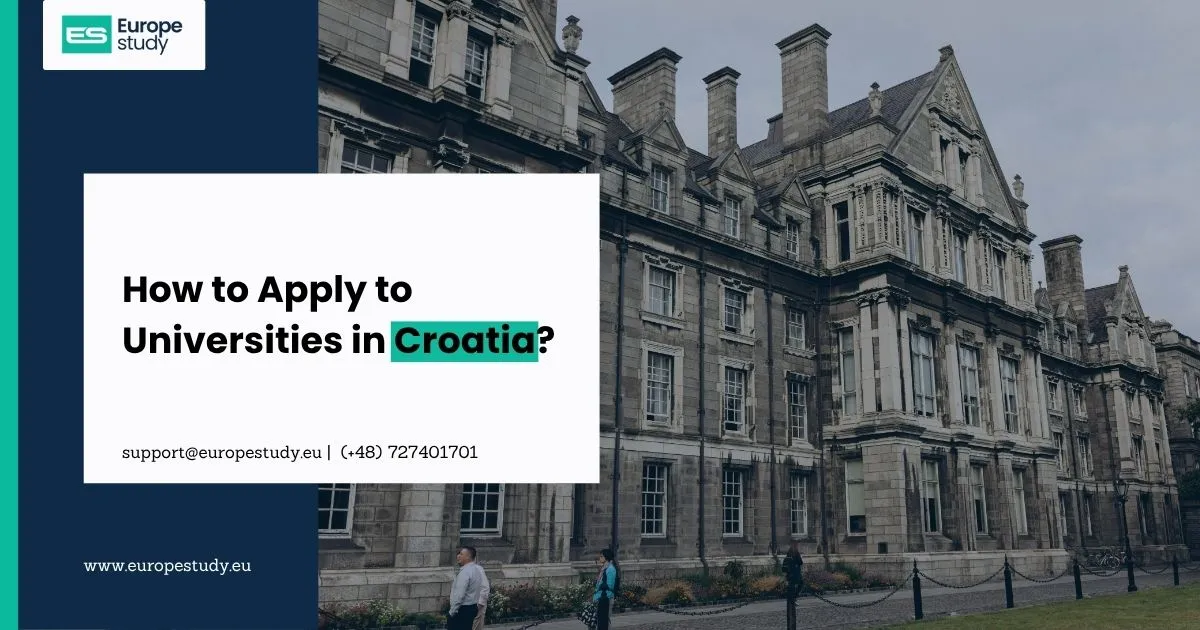
How to Apply to Universities in Croatia?
Planning to study in Croatia?
You’re making a great choice! Croatia is one of Europe’s most welcoming destinations for international students — combining quality education, affordable tuition, and beautiful surroundings along the Adriatic coast.
If you want to begin your studies here, it’s important to understand the application process, required documents, and deadlines.
This guide explains step-by-step how to apply to universities in Croatia for international students in 2025.
1. Choose Your Program and University
Croatia has a growing number of universities offering English-taught Bachelor’s, Master’s, and PhD programs in fields such as Business, Engineering, Tourism, Medicine, and Information Technology.
Popular institutions include:
-
University of Zagreb
-
University of Split
-
University of Rijeka
-
University of Dubrovnik
-
Zagreb School of Economics and Management
You can explore programs through university websites or centralized student application portals.
Make sure to check if your preferred course is offered in English or Croatian.
2. Check the Admission Requirements
Each university in Croatia sets its own admission criteria, but common requirements include:
-
Completed secondary education (for Bachelor’s applicants)
-
Bachelor’s degree (for Master’s applicants)
-
Proof of English proficiency (IELTS/TOEFL or equivalent)
-
Recognized academic transcripts
-
Valid passport copy
-
Motivation letter or Statement of Purpose
-
Curriculum Vitae (CV)
If you are applying for programs taught in Croatian, you will need to show language proficiency through a recognized certificate.
3. Prepare and Authenticate Your Documents
All your academic documents must be:
-
Officially translated into Croatian or English
-
Certified or apostilled according to international standards
-
Submitted in the format required by the university
Some institutions may require recognition (nostrification) of your previous qualifications by the Agency for Science and Higher Education (ASHE) in Croatia.
4. Submit Your Application Online
Applications for most Croatian universities can be submitted online through:
-
The national application system (for EU/EEA students)
-
Direct university application portals (for non-EU students)
You will need to create an account, fill out personal details, upload documents, and pay a small application fee (if applicable).
After submission, universities typically send a confirmation email and inform you if additional documents are needed.
5. Wait for the Admission Decision
Universities in Croatia usually announce admission results within a few weeks after the application deadline.
If accepted, you will receive:
-
An official offer letter, and
-
Instructions on how to confirm your place and pay tuition fees.
Once you receive your acceptance, you can begin preparing for your student visa application.
6. Apply for a Croatian Student Visa
If you are from a non-EU/EEA country, you must apply for a Type D student visa before travelling to Croatia.
To apply, you’ll need:
-
University acceptance letter
-
Proof of accommodation and finances
-
Valid health insurance
-
Passport (valid for at least 6 months)
You can submit your visa application at the nearest Croatian Embassy or Consulate in your country.
7. Arrive and Register in Croatia
Once your visa is approved, you can travel to Croatia and register your residence at the local police station (MUP) within a few days of arrival.
You will receive your temporary residence permit, allowing you to study legally throughout your program duration.
Application Deadlines (General Guide)
| Intake | Application Period | Semester Start |
|---|---|---|
| Winter Intake | February – July | October |
| Summer Intake | September – January | March/April |
Always double-check exact dates with your chosen university, as deadlines can vary by program and level of study.
Key Takeaways
-
Choose an English-taught program that fits your academic goals.
-
Prepare translated and legalized documents before applying.
-
Apply online through the university or centralized system.
-
Secure your Type D student visa before travelling.
-
Register your residence upon arrival in Croatia.
With proper preparation, studying in Croatia can be a smooth and rewarding experience!
FAQs
1. Can I study in Croatia without IELTS?
Yes, some universities accept proof of previous English-medium education instead of IELTS or TOEFL.
2. Are scholarships available for international students?
Yes. Several universities and government programs offer scholarships for outstanding international students.
3. How long does it take to get admission confirmation?
Usually between 2–6 weeks, depending on the university and program.
4. Can I work while studying in Croatia?
Yes. International students can work part-time during their studies and full-time during holidays.
5. Is it expensive to study in Croatia?
No. Tuition fees are affordable compared to Western Europe — typically between €2,000–€4,000 per year.